
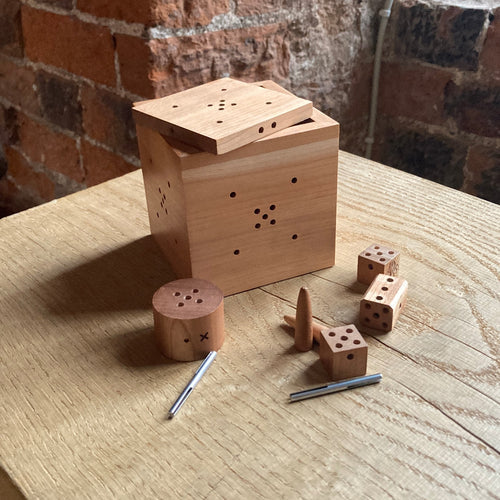
Thanks for plastic - but not in toys
Should your building kit be made of wood?
One of the most popular types of toys today, and probably throughout time, is undoubtedly building sets. The world's largest toy manufacturer is also a manufacturer of building sets. Other classics on the top 10 list are cars and dolls in all sorts of variations.
Perhaps it has to do with the fact that children are born with the ability to learn, to be naturally curious, and that construction toys are specifically designed to promote children's creativity, self-confidence and problem-solving abilities – all while they have fun and learn through hands-on, tactile play.
At WoodMee®, we believe that the playful approach of creating models, figures and games is the best way to support children in their natural development. A well-designed building set contributes, among other things, to:
✅ Mental stimulation – the child materializes their ideas and challenges the brain in a positive way.
✅ Strengthened self-esteem and pride – the child expresses their personality and creates something unique.
✅ Development of fine motor skills and spatial understanding - through playing with materials and construction.
✅ Problem-solving skills – by finding different solutions to complex challenges.
Free play, where the child is in control, is a platform for developing and expressing imagination and creativity. These are crucial skills for both the present and the future. WoodMee® wooden building sets are explicitly designed to inspire, support and nurture these skills, all with endless possibilities for expression through free imagination.

There are huge challenges with construction sets (and toys) – and for the toy industry
The toy industry is a $130 billion industry (excluding games) and is growing. It is also the industry in the world that consumes the most fossil plastic in terms of turnover of all industries. Globally, we are talking about approximately 6 million tons of fossil plastic.
We probably know this well as consumers, as it is difficult to walk into a toy store (online or physical) without seeing that almost all toys are made of plastic.
The toy industry has a huge plastic problem:
⛔️ 90% of all toys globally are made from fossil plastic.
⛔️ 80% of what we buy is thrown away. It can rarely be recycled and therefore becomes an even bigger source of pollution than production alone.
⛔️ In Denmark and the EU, we are not protected against dangerous chemicals in plastic toys - think TEMU.
⛔️ Older plastic toys do not meet the necessary regulations for harmful chemicals today. Your old Barbie, LEGO or Ninja Turtles (loved them) are not healthy to pass on to your children.
⛔️ Production of fossil plastic toys is growing.
Although the toy industry does not account for much in global plastic production compared to, for example, the clothing industry, it bears a great responsibility for making products for children that worsen the climate and thus the living conditions for them.

Global production of plastic in tons, graph from zet-land
____ ______
Are wooden toys the answer?
Yes, absolutely. WoodMee® was created precisely to prove that the most popular toy – construction sets – can be manufactured on an industrial scale in wood.
Wooden building kits come with a host of advantages:
🌱 Natural material – created by nature.
🌱 Authentic feeling – connects children with nature.
🌱 Robustness – often lasts for generations.
🌱 Timeless design - appeals to both children and adults.
🌱 Safe and free from added chemicals – from responsible producers.
🌱 Environmentally friendly production – wood is a renewable resource, especially from sustainable forestry.
🌱 Reduces plastic waste - contributes to less microplastics in nature.
🌱 Stimulates the senses – feels warm and tactile.
🌱 Promotes creativity – encourages free play and imagination.
🌱 Biophilic design – creates a calm and harmonious atmosphere.
🌱 Repairable – unlike plastic, wood can often be fixed.
This report documents the industry's consumption of plastic:
UNEP: Valuing Plastic .
And here is a good insight into global plastic consumption:
Our World in Data: Plastic Pollution .
Thanks for plastic – but not in toys
Plastic is a material that we cannot do without, for example in the pharmaceutical industry – think of ostomy bags, needles and other essential products. Wind turbines, electric cars and the space industry would not exist without plastic. We owe plastic a big thank you for these contributions and we could not function as a society without it.
But plastic has no place in products where it:
🔸 Not necessary.
🔸 Poses a health risk.
🔸 Designed without consideration for recycling or durability.
The toy industry is the largest proportional fossil plastic producer in terms of turnover. The industry is driven by a fast-fashion business model, where new products are quickly replaced, just like in the clothing industry. The result is an uncritical approach to plastic consumption and a "buy more and throw away" culture that is passed on to our children. Unfortunately, forecasts show that the consumption of plastic toys will only increase.
There is hope. Research into plastics is quite extensive and one scenario describes how plastic can be produced from captured C02, which almost makes plastic an advantage. See Zetland's fantastic article about just that here: Zetland: Plastic – Thanks and goodbye
__________
Let's together:
💡 Use plastic where it is really necessary.
💡 Teach children that plastic is a resource that should be used wisely.
💡 Design plastic products for recycling and long durability.
Best regards
Jesper, WoodMee®